Never miss an Awaab's Law deadline
Your housing management system was built to raise repair jobs, book operatives and show whether a job is open or closed. Awaab's Law asks a different question: did you investigate, tell the tenant and make the home safe within the legal timescales, and can you prove it? ComplianceIQ answers that question. It works alongside the system you already have, so there is nothing to replace.
What your current system does, and what Awaab's Law asks of you
A repair job with a status of open or closed.
A case for each hazard, from the day you became aware of it to the day the home is safe.
Target dates set by your own service standards.
Legal deadlines counted in working days, with weekends and bank holidays left out, and a warning before each one falls due.
Letters written separately, often in a word processor.
The letters the tenant must receive, filled in from the case, sent on time and kept on file.
Job notes, which staff can usually edit afterwards.
A record that cannot be altered, where any correction is added and shown rather than written over.
Reports on repair volumes and performance targets.
An evidence file you can hand to the Housing Ombudsman, your board or the Regulator of Social Housing.
To start, upload a spreadsheet of your homes exported from your housing system. Keep using it for repairs and rents; ComplianceIQ holds the legal record.
This short film follows a single damp and mould report through ComplianceIQ, from the tenant's first telephone call to an evidence file that is ready for the Housing Ombudsman. It runs for a little under two minutes, and you can pause it or move between scenes at any point.
"There's black mould on the bedroom ceiling, by the window. My youngest sleeps in there."
A tenant reports mould in their child's bedroom
At 16:40 on Christmas Eve, Ms Okafor telephones to report black mould on the bedroom ceiling, beside the window, in the room where their youngest child sleeps.
Read a transcript of the film
- A tenant reports mould in their child's bedroom. At 16:40 on Christmas Eve, Ms Okafor telephones to report black mould on the bedroom ceiling, beside the window, in the room where their youngest child sleeps.
- The legal clocks start as soon as the report is logged. ComplianceIQ sets up each of the timescales the regulations require: emergency action, investigation, the written summary, making the home safe and any preventative work. Each one starts automatically when the event that triggers it is recorded.
- Working days are counted for you. Most periods begin on the day after the relevant event and exclude weekends and bank holidays. A report made on Christmas Eve is therefore first counted on Tuesday 29 December, and ComplianceIQ works this out for you.
- Everyone is reminded before a deadline is missed. Your team, and whoever is carrying out the work, receive reminders at the halfway point, at 80% and on the day the deadline falls. Contractors receive their tasks by email and can mark them as complete from a secure link, without needing an account.
- The letters the law requires are prepared from the case. The written summary, progress updates, completion notice and any offer of alternative accommodation are drafted using the details already held on the case. You review each letter before it is sent, and the case records how and when it was given.
- The record cannot be altered after the event. Each entry is fingerprinted and linked to the one before it, so any later change would be detected. If something needs correcting, a new entry is added that shows the correction openly.
- Your evidence is ready whenever it is requested. You can export the full case file for the Housing Ombudsman, or a board pack covering every open case, in a single step. Sensitive household health notes remain private and are never included in an export.
- This is the workspace your team will use. Overdue and upcoming deadlines are shown first, every open report sits in a single register with its next deadline, and a board pack can be downloaded for any period. These screens are taken from our demonstration account.
- Never miss an Awaab's Law deadline. Start with your next report. The free seven-day trial includes every feature, and no payment card is required.
How it looks in ComplianceIQ
These screenshots are taken from our Awaab's Law demonstration account. The homes, tenants and staff shown in them are fictional.
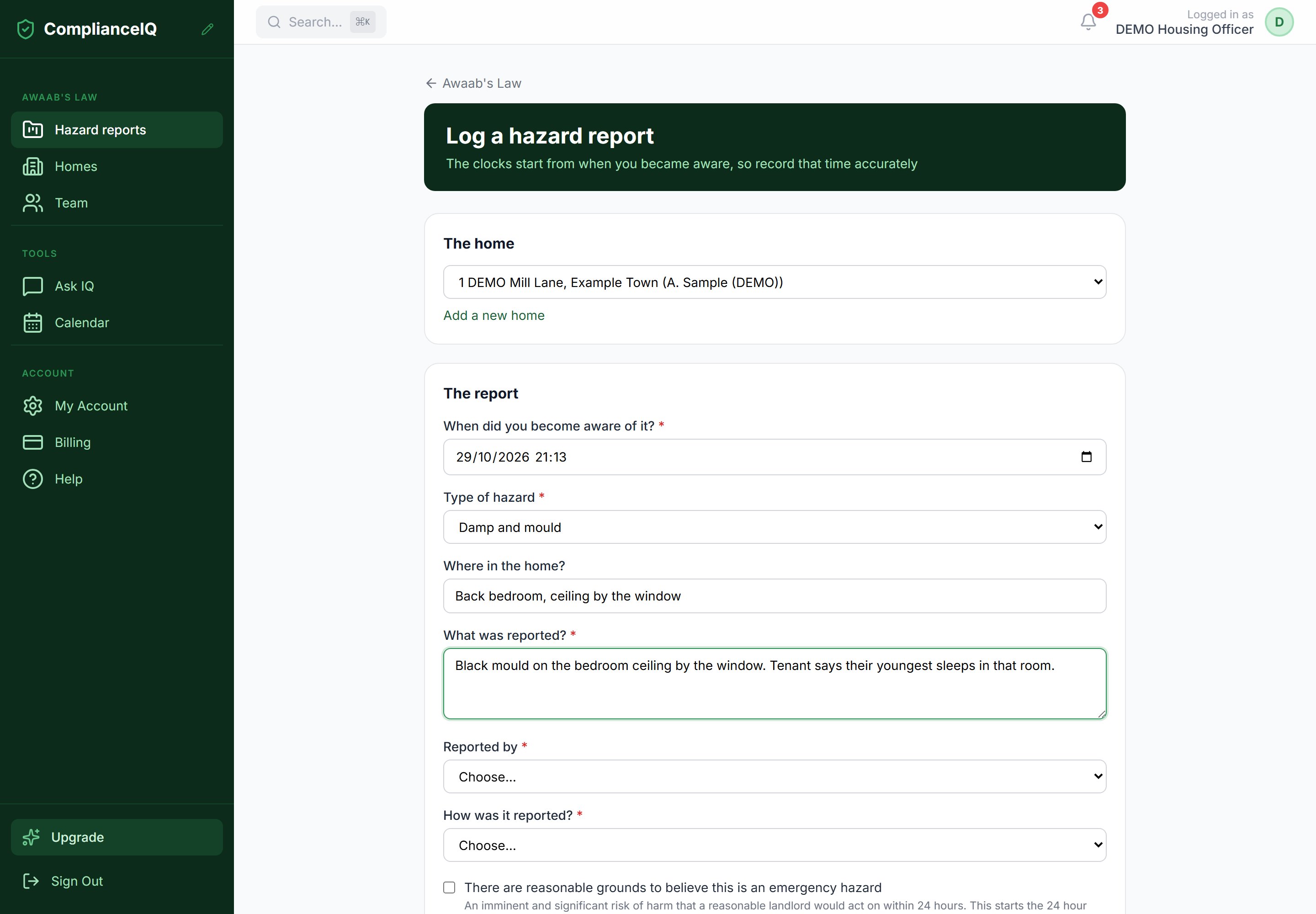
The facts the regulations rely on, captured first
The form begins by asking when you became aware of the hazard, because every clock is calculated from that moment. It then records the type of hazard, where it is in the home, what was reported and how.
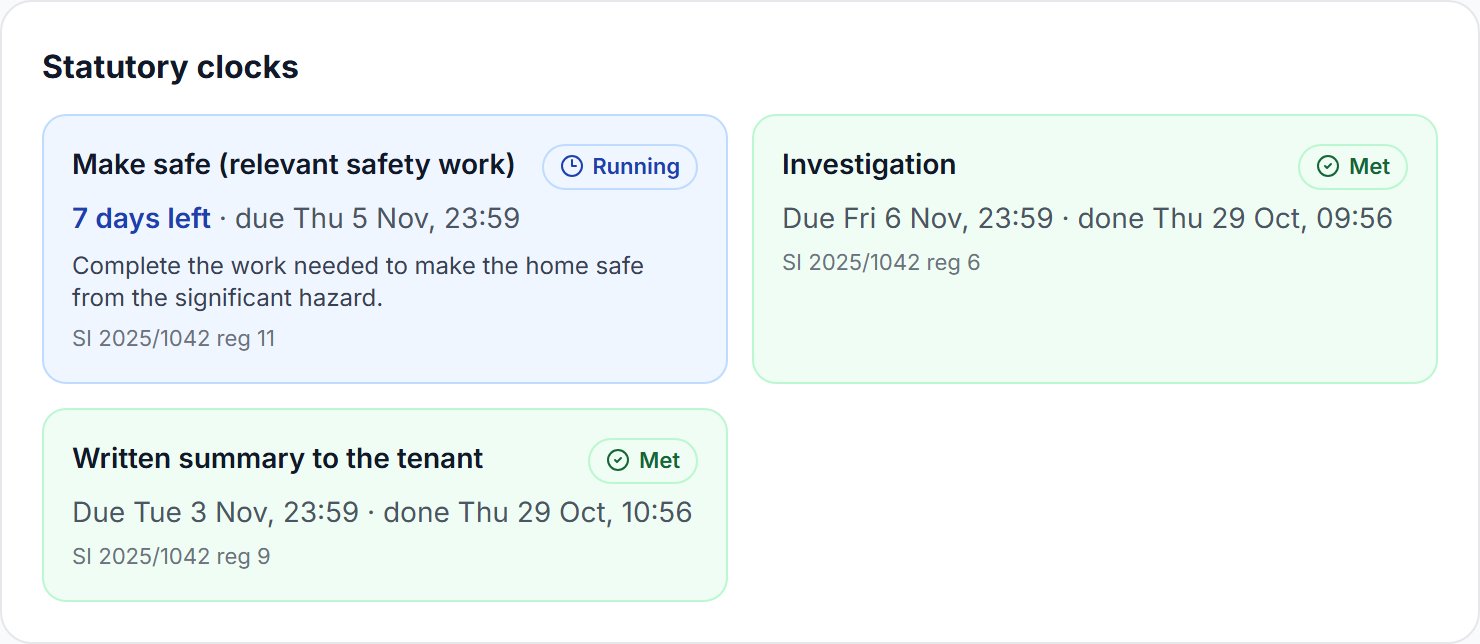
Every deadline on a case, with the regulation behind it
Each clock shows when it falls due, the regulation it comes from and whether it is still running or has been met. Recording an action stops the relevant clock and starts the next one.
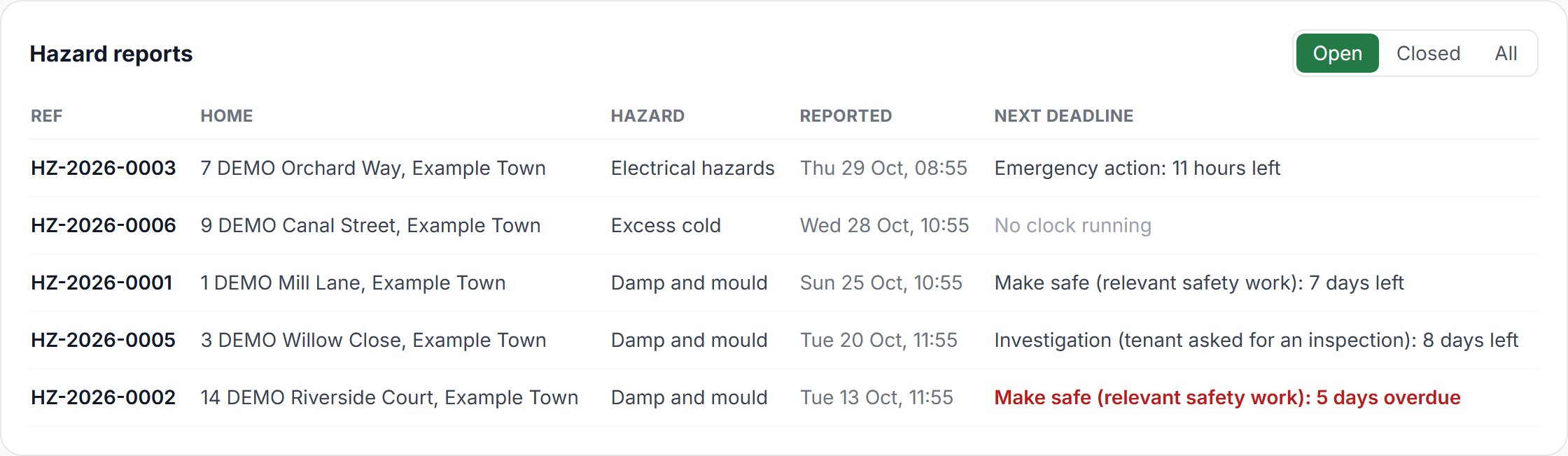
The most urgent cases are always seen first
Overdue and running deadlines sit at the top of the workspace. Below them, the register lists every open report with its home, hazard, reporting date and next deadline, and anything overdue is highlighted in red.

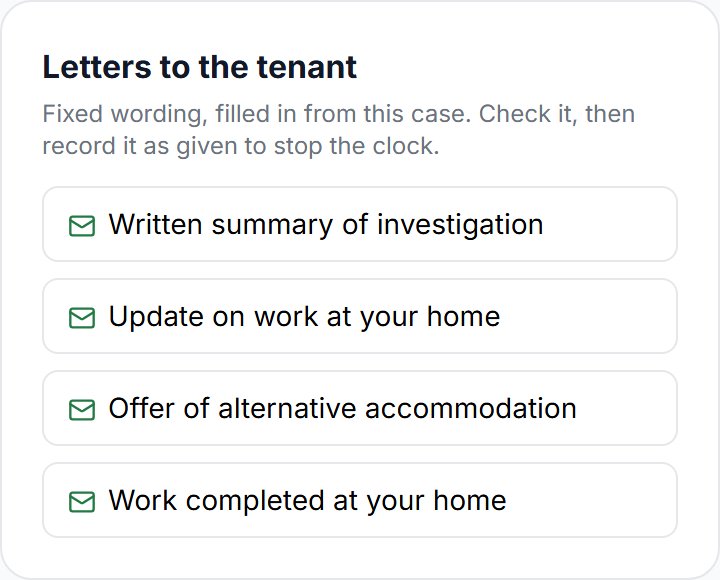
The letters the law requires, ready to check and send
The written summary, progress update, offer of alternative accommodation and completion letter use fixed wording and are filled in from the case. Once you have checked a letter, you record how it was given and the clock stops.
A record that shows it has not been altered
Every entry is timed, attributed to a named person and fingerprinted. The check at the top of the chronology confirms that no entry has been changed since it was recorded, and documents such as the written summary are attached to the entry they belong to.
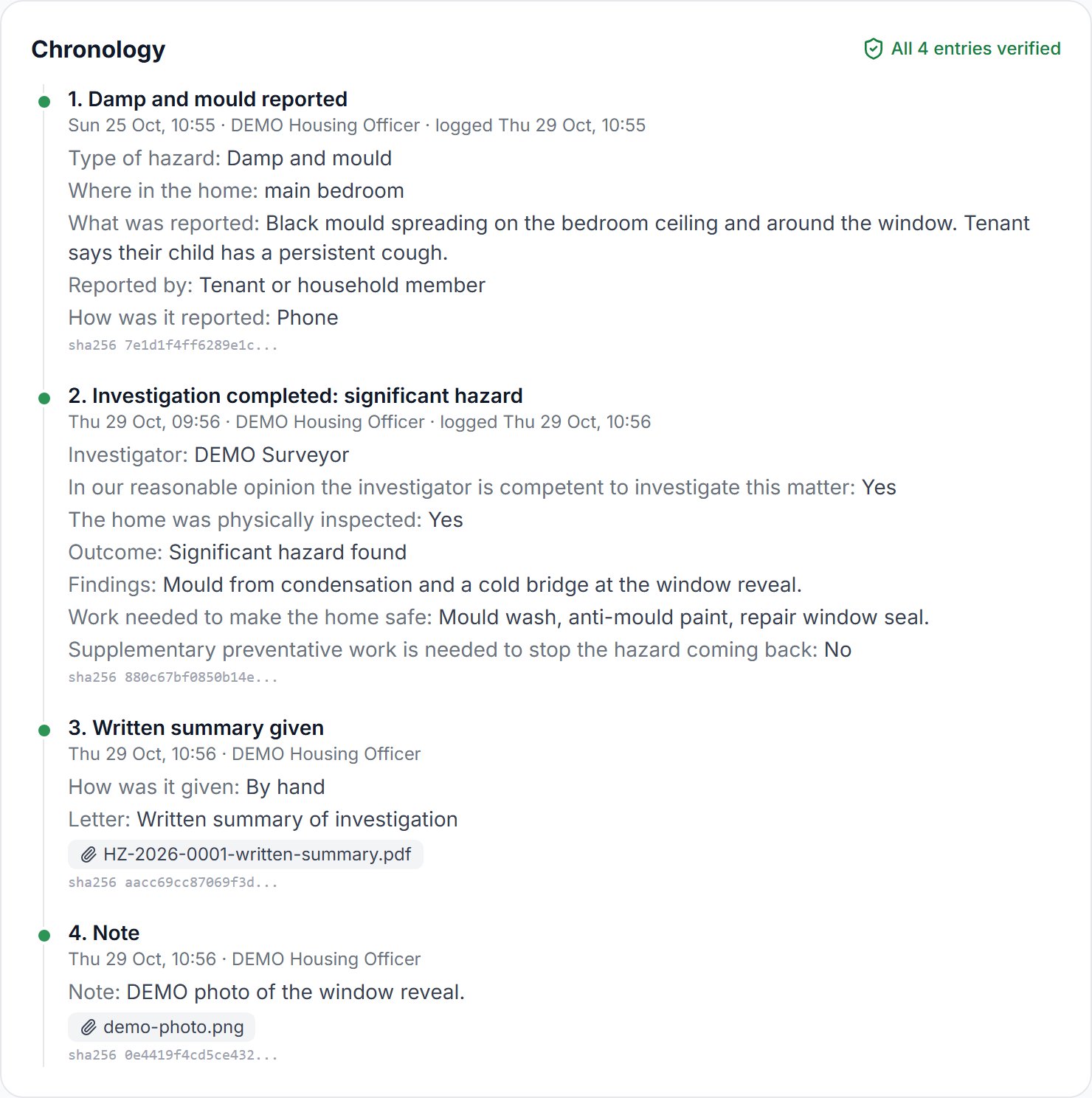
Case files and board packs in a single step
Each case can be downloaded as an evidence file or a full bundle for the Housing Ombudsman. The board pack reports how every deadline was handled over whichever period you choose.


Three steps to staying on top of Awaab's Law
A missed deadline is more than a late repair. It can leave a family living in an unsafe home, lead to a complaint to the Housing Ombudsman and prompt difficult questions from your board. Keeping track of it all should not depend on a spreadsheet and a wall calendar.
Log the report
Record what was reported, where in the home it is and when you became aware of it. The tenant's photographs can be added straight from a phone.
Follow the deadlines
Each deadline starts automatically and is counted in working days from the correct date. You are reminded before each one falls due and alerted if one is missed.
Show your evidence
Every action is held on a record that cannot be altered afterwards. You can export the case file for the Ombudsman, or a pack for your board, in a single step.
Ask IQ answers questions about the regulations in plain English.
CheckFix IQ reviews your damp and mould policy against the requirements.
Draft IQ helps you write any policies you do not yet have.
Your housing stock can be uploaded from an existing spreadsheet.
Start with your next report
Setting up takes a few minutes. Tell us about your homes and your team, upload your stock list, and the next damp report you log will be managed from the first day.
ComplianceIQ helps you meet your duties under the Hazards in Social Housing (Prescribed Requirements) (England) Regulations 2025. Decisions about hazards remain with you and your competent investigators, and nothing here is legal advice. The case, people, landlord and fingerprints shown are fictional examples.